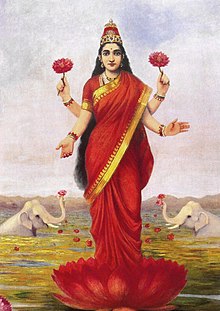
ORIGIN: Hindu (Epic and Puranic)
TYPE: Consort of Visnu
KNOWN PERIOD OF WORSHIP: circa 300 BCE and earlier, through to present times.
SYNONYMS: Sri-Laksmi; Sri-Devi; Dharani (earth); see also Sita.
CENTER(S) OF CULT: No temples but generally revered throughtout India.
ART REFERENCES: Sculptures generally bronze but also stone, reliefs.
LITERARY SOURCES: Ramayana and Mahabharata epics; Puranic literature.
INFORMATION: A major Hindu goddess who originated perhaps as a mother goddess but who now represents wealth and prosperity and epitomizes the later Hindu (Brahmanical) notion of the active female principle or Sakti in a male deity. According to the Ramayana, she arose from the primal Hindu sea of milk. Identified as the consort of Visnu from circa CE 400 onward, she is generally depicted as a beautiful golden-skinned woman possessing four, or more commonly two, arms. She stands or rests on a lotus which may be watered by two attendant elephants. Another favored portrait finds her washing Visnu's feet as he reclines on the thousand-headed serpent Sesha, and action which is said to bring Visnu dreams. She emerges in many guises, changing form as Visnu changes his own incarnations. She is perceived also to emerge as the black-skinned and destructive Kali. Many attributes, but most commonly a lotus.
Laksmi embodies the model Hindu wife, faithful and subsurvient. She may be depicted on the knee of Visnu's avatara Narayana as Laksmi-Narayana. She is reincarnated with each of his other Avatars—thus beside Rama she becomes Sita, said to have been born from a furrow, and with Krsna, she is first Radha, then Rukmini. She is worshiped particularly a the start of the business year in India. In the Divali (Feast of Lamps) on the last day of the dark lunar period toward the end of October or early in November, every household lights a lamp in honor of Laksmi. She is also propitiated by gambling.
COLOR: Golden
ATTRIBUTES: Bow and ornaments.